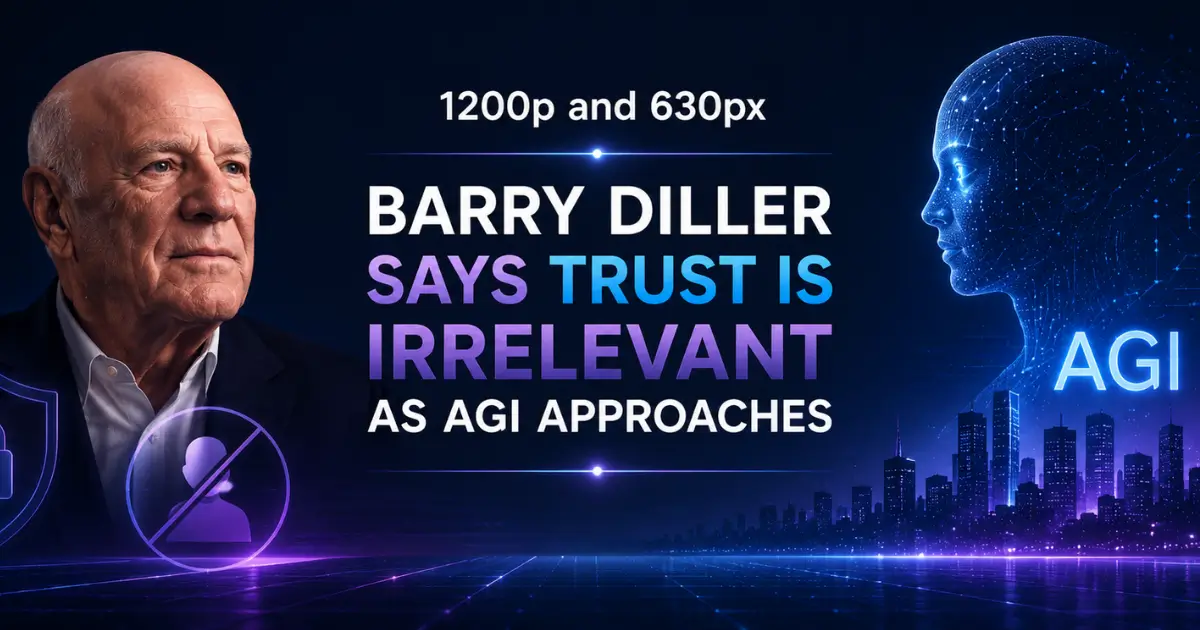
Billionaire media mogul Barry Diller says he trusts Sam Altman personally. But trust is irrelevant when it comes to AGI. Speaking at the Wall Street Journal's Future of Everything conference, Diller warned that even the people building AI do not know what will happen once artificial general intelligence arrives. The issue is not whether Altman is a good person. The issue is that AGI is an unpredictable force that no amount of personal character can control.
What Diller Said
Diller was asked whether people should put their faith in Altman to ensure AI benefits humanity. His answer was nuanced. He called Altman sincere and a decent person with good values. But he said that individual trustworthiness is beside the point.
The real concern, Diller argued, is that AI's consequences will surprise even its creators. He described spending time with people in the creation mode of AI and said they have a sense of wonder themselves. They do not fully understand what they are building. If the builders are surprised by what their technology does, trusting their intentions offers limited comfort.
Diller warned that without guardrails, an AGI force will create its own rules. Once that happens, there is no going back. His framing positioned AGI not as a technology problem but as a governance problem — one that cannot be solved by trusting any individual, no matter how well-intentioned.
Why It Matters Now
Diller's comments arrive during the Musk vs Altman trial, where the central question is exactly about trust. Musk claims Altman betrayed a charitable mission. Altman's team says Musk wanted control and left when he did not get it. Brockman testified that Musk proposed the same for-profit conversion he now condemns.
Diller's argument sidesteps the trial entirely. Whether Altman or Musk is more trustworthy is, in his view, the wrong question. The right question is whether any human can be trusted to manage a technology that surprises its own creators. His answer is that trust is irrelevant because the AI systems being built are approaching a threshold beyond any individual's ability to control.
The Safety Debate in Context
Diller's warning echoes concerns raised by Anthropic, which restricted its most powerful model from public release, and by OpenAI's own policy paper, which acknowledged that AI risks are too large for any single company to manage. Even OpenAI restricted its cybersecurity tool after discovering the same dangers Anthropic warned about.
The convergence is notable. Diller — an outsider to the AI industry — is making the same argument that insiders like Stuart Russell made under oath at the OpenAI trial. The pursuit of AGI is accelerating. The guardrails are not keeping pace. And the people building the technology admit they do not fully understand what it will do.
The Bigger Picture
Diller's comments matter because they come from someone with no financial stake in the AI race. He is not invested in OpenAI, Anthropic, or any AI company. He is not selling chips or cloud services. He is an observer — one of the most experienced media executives alive — watching the AI industry build something unprecedented and saying out loud what many are thinking privately.
The AI industry has spent years debating safety, governance, and trust. Diller's contribution is the simplest and most unsettling: it does not matter whether you trust the people building AI. What matters is whether anyone — anyone at all — can control what they are building. And the honest answer, from the builders themselves, is that they do not know.