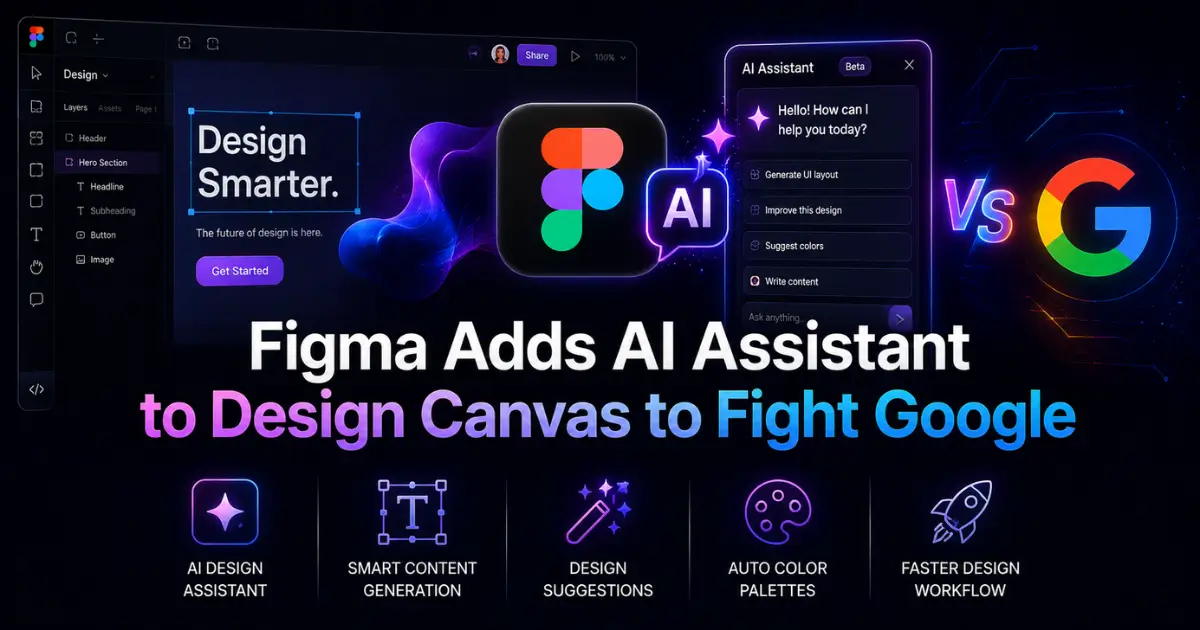
Figma has launched an AI assistant directly inside its collaborative design canvas. Designers can now describe what they want in natural language and the AI generates UI components, layouts, and design iterations in real time. The launch comes days after Google announced its own AI design offensive at I/O 2026 — putting Figma in a race to embed AI before the platform giants absorb its market.
What Figma Built
The AI assistant lives inside Figma's canvas — not in a sidebar or separate tool. Designers interact with it the same way they interact with other design elements. They can select a frame and ask the AI to generate a login form, a dashboard layout, or a navigation menu. The AI produces editable components that follow Figma's design system conventions.
The assistant also handles iteration. Designers can select an existing component and describe changes. "Make this button larger." "Add a dark mode variant." "Create a mobile version of this layout." The AI generates variations without affecting the original design.
Collaboration is built in. Multiple designers can see AI-generated suggestions simultaneously. They can accept, reject, or modify outputs as a team. The assistant understands the context of the broader project — ensuring generated components are consistent with the existing design language.
Why Figma Needs AI Now
The pressure on Figma is coming from multiple directions simultaneously. Google's I/O announcements included AI-powered design capabilities across Gemini Omni and Flow. Adobe has been integrating Firefly AI across Photoshop, Illustrator, and its design tools. And the vibe coding movement — where non-designers generate functional UIs through text prompts — threatens to make traditional design tools less necessary for certain use cases.
Lovable lets anyone build web apps from voice prompts. Google's Create My Widget lets Android users design custom widgets through natural language. And Replit is approaching $1 billion in revenue by letting non-technical users build and deploy software. If anyone can create functional interfaces without a designer, Figma's core value proposition evolves from essential to optional.
Figma's response is to make AI a force multiplier for professional designers rather than a replacement. The assistant does not design for you. It accelerates your design process. The distinction is critical for Figma's positioning.
The Competitive Landscape
The AI design market is fragmenting into tiers. At the consumer level, Google and Canva offer free or low-cost AI tools that anyone can use. At the professional level, Figma and Adobe compete for designers who need precision, collaboration, and production-ready output. And at the creative production level, ComfyUI gives power users node-based control over AI generation.
Figma's advantage is its collaborative workflow. Over 4 million designers use Figma. Their design systems, component libraries, and team workflows are deeply embedded in the platform. An AI assistant that understands those systems and generates components that fit them is more valuable than a generic AI image generator.
The risk is that Google or Adobe builds something comparable and bundles it with a larger product suite. Figma learned about acquisition risk the hard way — Adobe tried to buy the company for $20 billion in 2022 before regulators blocked the deal. Now both companies are competing for the same AI design market.
What It Means for Designers
For professional designers, Figma's AI assistant is likely welcome. It handles the tedious parts of design — generating variations, creating responsive layouts, producing component libraries — while leaving creative decisions to humans. The tool makes designers faster without making them unnecessary.
For junior designers, the implications are less clear. Entry-level design work — creating basic layouts, producing component variations, building design systems from templates — is exactly what the AI handles best. The same entry-level job compression affecting coding, legal, and other white-collar professions applies to design.
The Bigger Picture
Figma's AI assistant is a defensive move as much as an offensive one. The company needs AI to remain relevant as the design industry transforms. Google, Adobe, and a wave of vibe coding startups are all building toward a future where creating interfaces requires describing what you want rather than designing it pixel by pixel.
Figma is betting that professional designers will always need professional tools — and that those tools are more powerful with AI assistance than without it. Whether that bet holds depends on how quickly AI-generated design reaches a quality level where the distinction between professional and amateur output disappears.