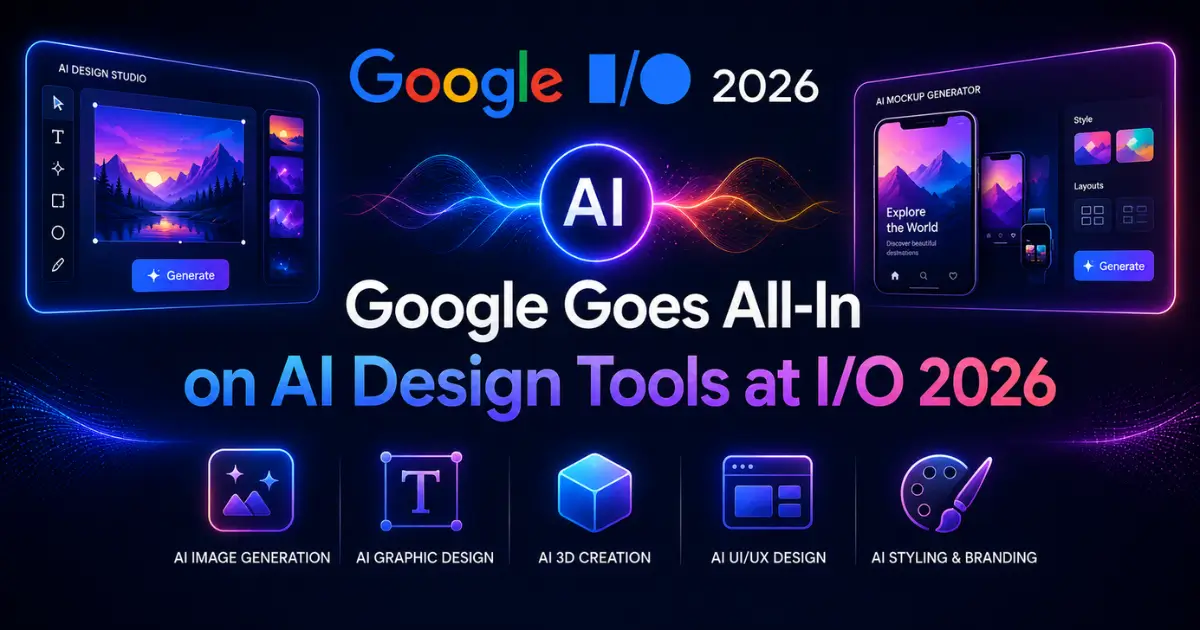
Google used its I/O developer conference to launch a suite of AI-powered design tools that put it in direct competition with Adobe, Canva, and Figma. The announcements include upgraded image and video generation through Gemini Omni, a new AI creative studio called Flow, and design capabilities embedded across Google's entire product ecosystem. The message from I/O is clear: Google wants to own AI-powered design from consumer selfies to enterprise brand campaigns.
What Google Announced
The design toolkit spans multiple products. Gemini Omni Flash generates and edits video from any combination of text, images, audio, and video. The upgraded Nano Banana model handles image generation and editing with improved text rendering — critical for logos, advertisements, and branded content. And Flow, Google's AI creative studio, now integrates both Omni and Nano Banana into a single workspace for professional creators.
Together, these tools let users generate images, edit photos, create videos, add custom avatars, and produce branded content through conversational prompts. No Photoshop. No After Effects. No design degree. Just describe what you want and Google's AI creates it.
The capabilities build on features Google has been rolling out across its ecosystem. Google Photos uses Gemini for wardrobe recommendations. Google Workspace embeds AI writing and spreadsheet generation. And YouTube is testing AI-powered search with guided answers. Adding professional design tools extends Google's AI reach into the creative market.
Why Design Is the Next Battleground
AI design tools are growing faster than almost any other AI category. AI image models drive 6.5x more app downloads than chatbot upgrades. ComfyUI hit a $500 million valuation giving professional creators granular control over AI generation. And ChatGPT Images 2.0 drove 5 million downloads in India during a single launch week.
The consumer demand is proven. The enterprise opportunity is enormous. Brands spend billions annually on creative production — photography, video, graphic design, advertising assets. AI tools that can produce professional-quality creative at a fraction of the cost and time represent one of the largest near-term revenue opportunities in the AI economy.
Google's advantage is distribution. Gemini already reaches billions of users across Chrome, Maps, Android, and cars. Adding design tools to that ecosystem gives every Google user access to professional creative capabilities without downloading a new app.
The Competition
Adobe has dominated professional design for decades. Photoshop, Illustrator, Premiere, and After Effects are industry standards. Adobe has been integrating its own AI — Firefly — across its suite. But Adobe's products are expensive, complex, and primarily serve professionals.
Canva democratized basic design for small businesses and social media creators. Figma owns collaborative interface design. Both have added AI features. But neither has the AI model capabilities or distribution reach that Google brings.
Google's play is to undercut all of them. Professional-quality design tools. Powered by frontier AI models. Embedded in products billions of people already use. At a price point — free for basic use through Gemini — that neither Adobe nor Canva can match.
The Creator Impact
For professional designers, the I/O announcements are a mixed signal. AI design tools make certain tasks dramatically faster. But they also make professional skills less scarce. If anyone can generate a branded video through a text prompt, the value of knowing After Effects diminishes.
The tension is the same one playing out across every creative industry. The Academy banned AI-generated performances from the Oscars. Artists are suing AI companies over unauthorized use of their work. And the debate over whether AI augments or replaces creative professionals intensifies with every new tool release.
Google's position is that AI design tools expand the market. More people creating means more creative output overall. But for individual designers competing against AI-generated alternatives, the expansion of the market may not compensate for the compression of their value.
The Bigger Picture
Google's AI design offensive at I/O 2026 is part of a larger pattern. The company is embedding AI into every surface it controls — from the search bar to the keyboard to the car dashboard to the creative studio. Each addition makes Google's ecosystem stickier and harder for competitors to match.
For the AI design market, the question is whether Google's integrated approach defeats the specialized tools that professionals already rely on. Adobe has decades of workflow integration. Canva has millions of templates. ComfyUI has granular creative control. Google has Gemini and 2 billion users. The battle for AI design is on.