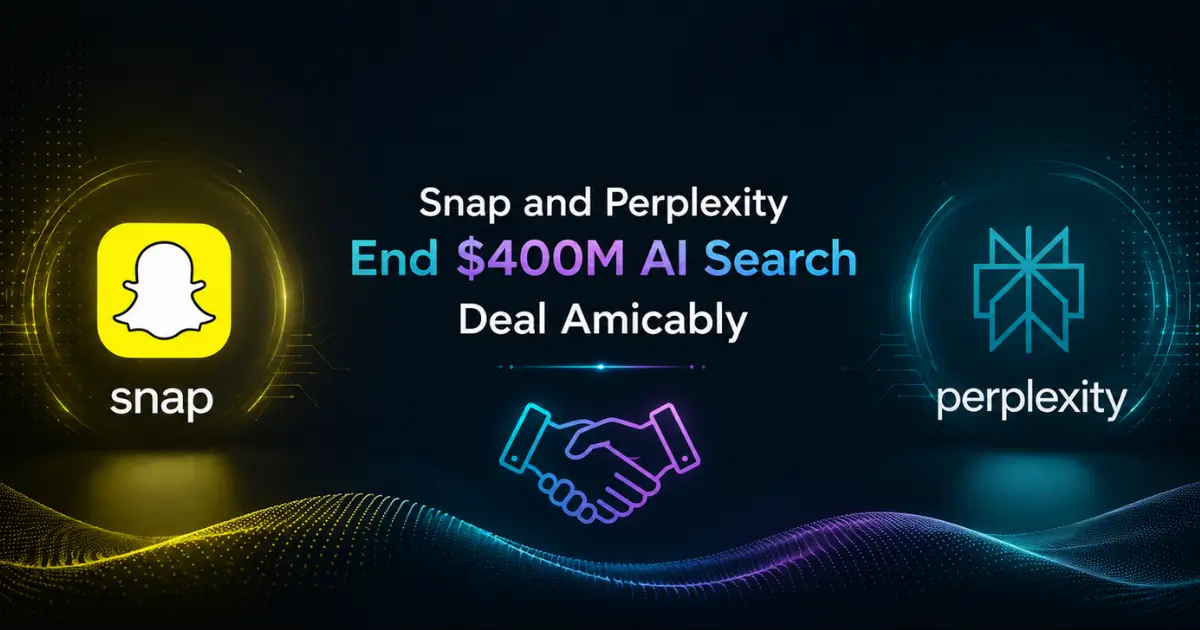
Snap and AI search startup Perplexity have ended their $400 million partnership. Snap CEO Evan Spiegel told investors the deal concluded amicably, with both companies choosing to pursue different strategic directions. The breakup comes as Snap integrates Google's Gemini into its products instead — and as Perplexity faces growing competition from Google's own AI search features.
What the Deal Was
Snap and Perplexity announced a multi-year partnership last year worth approximately $400 million. The deal embedded Perplexity's AI search capabilities into Snapchat, giving the app's 850 million monthly users access to AI-powered answers directly within the messaging platform.
The integration was designed to keep users inside Snapchat rather than switching to Google or ChatGPT to search for information. Perplexity gained massive distribution. Snap gained an AI feature that competitors were already offering through their own partnerships.
Why It Fell Apart
Spiegel described the separation as mutual. But the strategic context tells a different story. Snap has been deepening its relationship with Google. The company is now integrating Gemini directly into Snapchat for AI-powered features — a move that makes a separate Perplexity integration redundant.
Google's AI capabilities have expanded dramatically in recent months. Gemini now powers features across Chrome, Maps, Workspace, YouTube, Google TV, and millions of vehicles. For Snap, partnering with Google provides a more comprehensive AI stack than any standalone search startup can offer.
For Perplexity, the loss of Snap's 850 million users is significant. The startup has been building its own consumer products — including the Comet browser — but losing a distribution channel of this scale creates pressure to find alternatives quickly.
The Broader AI Search Landscape
The Snap-Perplexity breakup reflects a broader consolidation in AI search. The first wave of partnerships saw established platforms integrating AI search startups to quickly add capabilities. The second wave is seeing those same platforms replace startups with offerings from the major AI labs — Google, OpenAI, and Anthropic — which offer deeper integration and more comprehensive capabilities.
Google's aggressive expansion of AI search features has been particularly damaging for standalone search startups. When Google embeds AI answers directly into its search results, pulls expert advice from Reddit, and offers guided answers in YouTube, the value proposition of a separate AI search tool narrows significantly.
OpenAI has also been expanding its search capabilities. GPT-5.5 Instant can now search across past conversations, files, and Gmail. The superapp vision that Greg Brockman outlined combines chat, code, and browsing into a single platform. Both moves eat into the market that Perplexity has been trying to own.
What It Means for Perplexity
Perplexity remains one of the most innovative AI search products available. Its answer engine approach — providing direct answers with citations rather than links — defined a category. But the company is now sandwiched between Google's AI search on one side and ChatGPT's expanding search capabilities on the other.
The $400 million Snap deal was validation. Its ending is a reminder that distribution partnerships in AI are fragile. When the platform partner builds or buys the same capability internally, the startup becomes redundant.
The Bigger Picture
The Snap-Perplexity breakup is a cautionary tale for every AI startup that depends on distribution partnerships with larger platforms. In the AI era, the major platforms are building AI capabilities faster than startups can establish permanent positions. Today's partnership is tomorrow's internal feature.
For enterprise AI companies with deep workflow integration, the risk is lower. For consumer-facing AI tools that rely on platform distribution, the risk is existential. Perplexity still has a strong product and a loyal user base. But it just lost access to 850 million potential users and the company that replaced it is not a startup. It is Google.